
30 year fixed vs 15 year mortgage: Compare Costs and Payments
Compare 30 year fixed vs 15 year mortgage options, including payments, interest costs, and pros and cons, to find the right fit for your budget and goals.
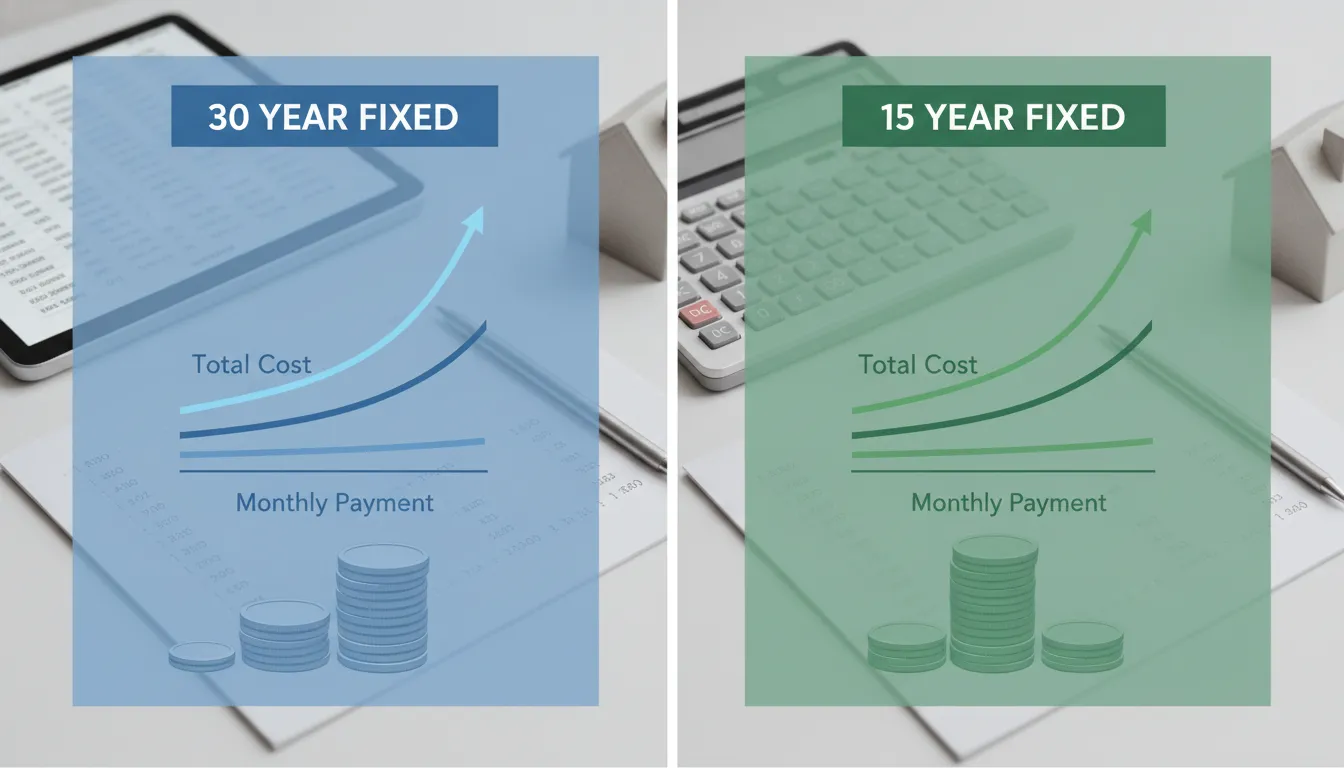
A lower mortgage payment can free up room in your monthly budget, while a shorter payoff schedule can help you repay your home sooner. That’s the central tradeoff behind a 30 year fixed vs 15 year mortgage. But the best choice depends on more than the payment shown in an online calculator. The rate you qualify for, your down payment, loan program, and other housing expenses all influence the total cost. Your plans matter, too, including how long you expect to stay in the home and whether you value payment flexibility or a faster payoff. This guide will help you compare both terms with clear assumptions and questions to ask a mortgage professional.
Key Takeaways
- Match the mortgage term to your budget: A 15-year loan typically has higher monthly payments and a faster payoff, while a 30-year loan generally offers a lower required payment.
- Compare complete loan estimates: Review rates, APR, fees, closing costs, taxes, insurance, and mortgage insurance using the same loan amount and down payment.
- Consider your broader financial plans: Account for savings, debts, future expenses, and how long you expect to keep the home or loan. Request a personalized quote or refinance analysis to assess your options.
How Do 30-Year and 15-Year Mortgages Differ?
Both terms can finance the same home, but they shape your payment schedule, total interest costs, and pace of equity growth differently. Understanding what changes, and what stays the same, can help you compare mortgage options with your budget and plans in mind.
Compare loan terms, repayment schedules, and fixed principal-and-interest payments
A 30-year mortgage is repaid over 360 monthly payments, while a 15-year mortgage is repaid over 180. With the shorter term, you repay the loan in half the time. That usually means a higher required monthly payment, even if the 15-year loan has a lower interest rate.
For both fixed-rate loans, the principal-and-interest portion of your payment stays the same over the loan term. Each payment covers interest and reduces your principal, though the balance generally declines faster on a 15-year schedule. Chase’s comparison of 15- and 30-year mortgages explains how the repayment timelines differ. Your actual payment depends on factors such as the loan amount and the rate you qualify for.
Know what stays fixed and what can change in your housing costs
A fixed rate keeps your principal-and-interest payment predictable, but it does not lock in every housing expense. Property taxes and homeowners insurance can change over time. If your lender collects these costs through escrow, your total monthly payment may change as well. Mortgage insurance, if required, also affects your housing costs.
When you compare terms, look beyond principal and interest. Estimate the full monthly cost, including taxes, insurance, and any mortgage insurance, and check how much cash you’ll need at closing. Your costs may also vary based on your down payment, loan program, and property. Great Western Funding provides home-purchase loan guidance and personalized comparisons to help borrowers review their options.
See how loan term affects payoff time and equity growth
A 15-year mortgage pays down principal faster, which generally helps you build equity sooner and pay less interest over the life of the loan. A 30-year mortgage takes longer to repay and typically costs more in total interest, but its lower required payment may leave more room in your budget for savings or other expenses. CNBC’s overview of choosing between mortgage terms also highlights the link between payment size and equity growth.
Your results depend on the loan amount, interest rate, and fees. To make a fair comparison, request quotes for both terms using the same loan amount and down payment. Then weigh the monthly payment against the total repayment and your other financial priorities.
How Do Monthly Payments Compare?
A monthly mortgage payment is only one part of the cost of owning a home, but comparing it can help you see how each loan term fits your budget. Start by comparing principal and interest, then account for taxes, insurance, and other expenses.
Understand why 15-year mortgages usually require higher payments
With a 15-year mortgage, you repay the loan in half the time of a 30-year mortgage. That means each scheduled payment generally covers more of the principal, so the required monthly payment is usually higher. A 15-year loan may have a lower interest rate, but that does not necessarily make its monthly payment lower.
In return for the larger payment, you pay off the mortgage sooner and typically pay less interest over the full loan term, assuming you make payments as agreed and keep the loan for its full term. A 15-year mortgage may be a good fit if the payment leaves room for your other obligations, savings, and emergency fund. Lower Mortgage’s comparison explains this tradeoff between payment size and repayment time.
Compare the same loan amount and down payment using stated rate assumptions
For a useful comparison, look at 15- and 30-year loans with the same loan amount and down payment. Check the interest rate and other assumptions behind each estimate, since a difference in those details can make the payments harder to compare.
In one example, CNBC Select reports monthly principal-and-interest payments of $1,145.80 for a 30-year mortgage and $1,775.25 for a 15-year mortgage. The 15-year payment is $629.45 higher in that example. It’s an illustration, not a quote for your situation: your payment depends on your loan balance, rate, and loan details. Great Western Funding can help you compare personalized mortgage options.
Separate principal and interest from taxes, insurance, mortgage insurance, and other costs
Principal and interest make up only part of your monthly housing costs. Depending on the property and loan, you may also need to budget for property taxes, homeowners insurance, private mortgage insurance (PMI), and homeowners association (HOA) fees. Some expenses may be included in your monthly mortgage payment, while others, such as HOA fees, are often billed separately.
These costs vary by location, property, down payment, and loan program. When you review a payment estimate, check which items it includes and which you’ll need to pay separately. This gives you a clearer picture of what homeownership may cost each month. Bankrate’s guide to comparing mortgage terms outlines common expenses to consider beyond principal and interest.
Check how each payment fits your budget, debts, savings, and upcoming expenses
Compare the estimated full housing payment with your take-home income and regular expenses. Include debt payments, utilities, childcare, savings goals, and costs you expect in the future, such as home repairs or tuition. Leave room for unexpected bills, too. A payment that works only when everything goes as planned may put pressure on your finances.
A 15-year term may suit you if your income is stable and the higher payment still leaves enough for savings and other priorities. If it would make your budget feel tight, a 30-year term may provide more flexibility. Bankrate recommends considering your income and financial circumstances when weighing a shorter term. You can also request a personalized quote to compare payments based on your circumstances.
How Do Rates Affect Total Mortgage Costs?
The interest rate is a major part of your mortgage cost, but it isn’t the only one. Loan term, upfront fees, discount points, and how long you keep the loan all affect what you pay. Compare complete quotes for both terms using the same assumptions, then consider how each option fits your budget and plans.
Learn why 15-year rates may be lower—and why quotes vary
Lenders often offer lower rates on 15-year mortgages than on 30-year mortgages. A shorter term means the loan is repaid sooner, and a lower rate can make that option appealing. The difference between terms changes with market conditions, though, so check current quotes rather than relying on a general trend. Freddie Mac’s mortgage rate data can provide market context, but it can’t tell you the rate you’ll qualify for.
Your quote may depend on your credit, down payment, loan amount, property, and loan program. A conventional loan may be priced differently from an FHA, VA, USDA, or jumbo loan. To compare terms fairly, request quotes with matching details and review Great Western Funding’s home loan options.
Compare how loan term and rate affect total interest and repayment
A 15-year mortgage usually has a higher monthly principal-and-interest payment because you repay the loan in less time. However, you make fewer payments, and the rate may be lower, which can reduce total interest. A 30-year mortgage spreads repayment over more months, typically lowering the required payment but increasing total interest if you keep the loan for the full term. Chase’s comparison of 15- and 30-year mortgages explains how a shorter term can reduce interest paid over time.
For a useful comparison, use the same loan amount and down payment for both quotes. Review each monthly payment and estimated interest over the period you expect to keep the loan. The full-term cost is a reference point, not a prediction: selling, refinancing, or making extra principal payments can change what you ultimately pay.
Compare APR, points, and lender fees—not just advertised rates
An advertised interest rate doesn’t show every cost of getting a mortgage. Compare the annual percentage rate, or APR, as well as the interest rate. APR includes the rate and certain loan charges, which can make it useful when reviewing offers, but it doesn’t replace checking the itemized costs.
Ask whether a quote includes discount points, an upfront charge that may lower your interest rate. Points can make sense if the monthly savings outweigh the initial cost during the time you keep the loan. Request estimates with and without points, and compare origination fees and other closing costs. The Consumer Financial Protection Bureau’s guide to the Loan Estimate explains how to review these charges and compare offers.
Treat market forecasts and potential investment returns as uncertain
Predictions that rates will rise or fall aren’t guarantees. Future home values, refinancing opportunities, and investment returns are uncertain, too. Base your decision on the rate and terms available to you, along with a payment you can comfortably manage. Consider how the payment fits alongside savings, other debts, and regular expenses.
Think about how long you expect to keep the home or mortgage. If you sell or refinance before the term ends, you may pay less interest than a full-term estimate suggests. When refinancing, compare closing costs with the savings you expect over the time you’ll keep the new loan. Great Western Funding offers a refinance analysis to help you assess the numbers for your situation.
What Are the Pros and Cons of Each Mortgage Term?
A 15-year or 30-year fixed mortgage can provide predictable principal-and-interest payments, but the term affects your required monthly payment, payoff timeline, and total interest. The right choice depends on how each option fits your budget and priorities. Compare personalized quotes for both terms, and remember that taxes, insurance, and other housing costs can change your total monthly payment.
30-year fixed: Make lower required payments and keep more flexibility
A 30-year fixed mortgage spreads repayment over a longer period, so its required principal-and-interest payment is usually lower than that of a 15-year loan for the same loan amount. That can leave more room in your monthly budget for savings, home repairs, childcare, or other expenses.
The lower required payment can also give you options. When your budget allows, you may be able to pay extra toward principal and reduce your balance faster. You can keep the contractual payment lower for months when money is tight, then make additional payments when it works for you. Check your loan terms for any prepayment restrictions. Compare home-purchase loan options to see how different terms may affect your estimated payment. A 30-year mortgage can suit borrowers who value a lower required payment and flexibility.
30-year fixed: Take longer to repay and typically pay more interest overall
The tradeoff for a lower required payment is a longer repayment period. With a 30-year mortgage, you take more time to pay down the principal, and interest generally has more time to accumulate. If you make only the scheduled payments, you’ll typically pay more total interest over the life of a 30-year loan than you would on a comparable 15-year loan.
The difference depends on the loan amount, interest rate, and any extra payments you make. When comparing options, look beyond the monthly payment: review the projected total interest and payoff date, too. Shorter-term loans generally cost less in total interest because borrowers repay the balance sooner. Ask a mortgage professional to show how extra principal payments could affect your own timeline and costs.
15-year mortgage: Pay off faster, build equity sooner, and potentially pay less interest
A 15-year mortgage is scheduled to be paid off in half the time of a 30-year loan. Because you repay principal more quickly, you can build equity sooner, assuming other factors, such as your home’s value, remain unchanged. The shorter repayment period also typically means less total interest. Some lenders may offer a lower rate for a 15-year loan, but rates vary by borrower, lender, and loan details.
This option may appeal if you want to own your home outright sooner or reduce long-term borrowing costs. Compare offers using the same loan amount and down payment, and review the rate, APR, fees, and estimated total interest. Paying off a mortgage sooner can be a meaningful benefit, but weigh it against the higher required payment before deciding.
15-year mortgage: Make higher payments and leave less room for other priorities
A 15-year mortgage usually requires a higher monthly principal-and-interest payment than a comparable 30-year loan. Before choosing one, check that the payment fits your regular expenses and leaves room for emergency savings, retirement contributions, home maintenance, and other priorities. A payment that feels manageable now may become more difficult if your income or expenses change.
Principal and interest are only part of your housing costs. Property taxes, homeowners insurance, mortgage insurance, and homeowners association fees can add to your monthly total. Ask for estimates that include these expenses, rather than comparing principal and interest alone. As Chase explains, it’s important to make sure the higher payment fits your budget. Current homeowners can also request a refinance analysis to compare potential payments and costs for different terms.
Which Mortgage Term Fits Your Financial Goals?
The right mortgage term is the one that fits your monthly budget and the rest of your financial life. A 15-year loan can help you repay your home sooner, while a 30-year loan usually has a lower required payment. Compare both options using your current finances, future plans, and the costs of each loan, rather than choosing based on the term alone.
Weigh income stability, debt, emergency savings, and planned expenses
Start with the payment you can manage consistently, not just the amount a lender may approve. A 15-year mortgage generally has a higher monthly principal-and-interest payment, so consider how much money remains after paying other debts and regular expenses. If your income changes from month to month, leave room for slower periods or unexpected costs.
Keep emergency savings and upcoming expenses in the picture, too. Home repairs, medical bills, childcare, or a change in income can make a tight budget difficult to manage. A 30-year mortgage typically has a lower required payment, which may leave more flexibility. As Lower’s 15- and 30-year mortgage comparison notes, borrowers with a 30-year loan may also pay extra principal when their budget allows.
Balance mortgage payments with retirement savings, investing, and other goals
A larger mortgage payment can help you repay your home sooner, but it should fit alongside your other priorities. Consider whether a 15-year term would leave enough room for retirement contributions, savings, and planned expenses. The right balance depends on your income, debt, and goals, as well as the interest you may save by paying off the loan sooner.
If the higher payment fits comfortably and your income is stable, a 15-year mortgage may be a good fit. If it would require you to pause savings or rely on credit to cover an unexpected expense, a longer term may be more manageable. Bankrate’s guide to comparing mortgage terms also recommends considering whether you can comfortably afford the payment throughout the loan term.
Consider how long you expect to keep the home or loan
Think about how long you expect to own the home and keep the mortgage. If you plan to stay for many years, a fixed-rate mortgage can provide predictable principal-and-interest payments for the selected term. If you may move or refinance sooner, compare each loan’s costs and benefits over the period you expect to keep it.
Plans can change, so be cautious about choosing a loan based on a move or refinance that is not certain. Compare quotes for both terms, including payments, closing costs, and how quickly you expect to build equity. If you’re buying a home, Great Western Funding offers purchase loan guidance to help you review available mortgage options.
Choose between payment flexibility and a faster payoff
A 30-year term usually means a lower required monthly payment, leaving more room in your budget. A 15-year term generally requires higher payments, but it pays down principal faster and can help you build equity sooner. Decide which matters more for your circumstances: a lower monthly obligation or an accelerated payoff.
Look beyond the monthly payment when comparing options. A 15-year loan may have a lower interest rate, but rates and fees vary by lender and borrower. Ask for quotes using the same loan amount and down payment, then compare the estimated payments and total interest. CNBC’s overview of 15- and 30-year mortgages explains how a faster repayment schedule can help borrowers build equity sooner.
Consider a 30-year term with optional extra principal payments
A 30-year mortgage may suit borrowers who want a lower required payment but also want the option to repay the balance faster. If you have extra money available, you may be able to make additional principal payments, depending on your loan terms. Paying extra can reduce the balance sooner, though the effect depends on the interest rate, timing, and amount of those payments.
This approach offers flexibility, but avoid relying on future bonuses or income increases to make the required payment. Choose a monthly obligation you can afford with your regular income. If you’re weighing a new loan against a refinance, Great Western Funding can provide a personalized refinance analysis to help you compare options.
Check for prepayment penalties and keep cash reserves accessible
Before making extra payments, review your mortgage documents or ask your lender whether a prepayment penalty applies. Loan terms vary, so confirm how additional payments are handled and whether you need to specify that they go toward principal. Your servicer may also have a particular process for submitting extra funds.
Keep cash available for emergencies and planned expenses before putting spare money toward your mortgage. Paying down principal can reduce debt, but that money may be difficult to access again if your circumstances change. Chase’s comparison of 15- and 30-year mortgages advises making sure a higher payment fits your budget before committing to a shorter term.
What Mortgage Misconceptions Should You Avoid?
A monthly payment or interest rate alone can’t tell you which mortgage term is the better fit. Compare the full cost of each loan, then consider how its payments work with your budget and priorities. These common misconceptions can help you focus on the details that matter.
A lower 30-year payment doesn’t mean the loan costs less overall
A 30-year mortgage spreads repayment over a longer period, so its required monthly principal-and-interest payment is usually lower than that of a 15-year mortgage for the same loan amount. But a smaller payment doesn’t necessarily mean a smaller total cost. With more time for interest to accrue, borrowers typically pay more interest over the life of a 30-year loan.
Compare the total interest as well as the monthly payment, using quotes for the same loan amount and similar costs. This comparison of 15- and 30-year mortgage costs illustrates how the repayment period can affect total interest. Your own figures will depend on your rate, fees, and loan terms.
A 15-year mortgage isn’t automatically unaffordable—or right for everyone
A 15-year mortgage usually has a higher monthly principal-and-interest payment, but that doesn’t make it automatically out of reach. If your income is steady and the payment fits alongside your regular expenses, savings, and other debts, the shorter term may suit your goals.
It may not be the right fit if the larger payment leaves little room for emergencies or upcoming costs. Review both options against your full monthly budget, not just your estimated mortgage payment. A 15- and 30-year mortgage calculator can help you compare payment scenarios. For a more specific estimate, request a quote based on your loan amount, down payment, and financial details.
A lower 15-year rate doesn’t guarantee a better choice
Lenders may offer a lower interest rate on a 15-year mortgage than on a 30-year loan. Still, the shorter term generally requires a higher monthly payment, so the rate alone can’t tell you which option works best. Consider the payment and total interest, along with points, lender fees, and other loan costs.
Ask for quotes for both terms using the same loan amount and down payment. Compare the annual percentage rate (APR), which reflects certain loan costs, as well as the estimated payment. Chase’s comparison of 15- and 30-year mortgages explains why a lower rate can still come with a larger monthly payment.
Mortgage-interest tax benefits depend on your circumstances
Don’t assume that a mortgage-interest deduction will make one loan term the better financial choice. Whether you can deduct interest depends on your tax circumstances and applicable rules, including whether you itemize deductions and whether your loan qualifies. The potential benefit can differ from one borrower to another.
If taxes are part of your decision, ask a qualified tax professional how each option may affect your return. The IRS guidance on mortgage-interest deductions explains the rules and eligibility requirements. Compare the loans based on their payments, fees, and total interest, too. For help reviewing purchase options, you can request a personalized home-purchase quote.
Faster equity growth doesn’t replace emergency savings
A 15-year mortgage can help you build equity faster because you repay principal more quickly. That may appeal if paying off your home sooner is a priority. But home equity isn’t the same as cash in your bank account. Accessing it may require selling your home or qualifying for a new loan, so it may not be available when an unexpected expense comes up.
Before taking on a higher payment, check that your budget still leaves room for an emergency fund and other goals. CNBC’s guide to choosing between mortgage terms describes faster equity growth as a potential advantage of a 15-year mortgage. Weigh that benefit against the value of keeping accessible savings for repairs, medical bills, or a change in income.
How Do You Compare 15- and 30-Year Mortgage Quotes?
A fair comparison starts with consistent assumptions. When quotes differ in loan amount, down payment, loan type, or fees, it can be hard to tell whether the difference comes from the term or another factor. Ask lenders for comparable estimates, then review the monthly payment and the costs you may pay upfront.
Look beyond the principal-and-interest amount. Taxes, homeowners insurance, mortgage insurance, and other housing costs affect what you’ll pay each month. If you’re refinancing, include the costs of the new loan and think about how long you expect to keep it. The steps below can help you compare offers and prepare useful questions for a mortgage professional.
Request quotes for both terms with the same loan amount and down payment
Ask for 15- and 30-year quotes based on the same loan amount and down payment. This gives you a clearer view of how the term and interest rate affect monthly payments and total interest. Chase recommends using consistent loan details when comparing the two options.
Check that both quotes also use the same loan type and rate structure, such as a fixed-rate mortgage. Note each quote’s interest rate, whether the rate is locked, and when the estimate was prepared. Mortgage pricing can change, so quotes from different dates may reflect different market conditions. If any assumptions vary, ask the lender to provide a revised estimate so you can compare like with like.
Compare estimated monthly housing costs, APR, points, and closing costs
Compare the estimated monthly housing payment, annual percentage rate (APR), discount points, lender fees, and closing costs. The principal-and-interest payment does not include every housing expense. Property taxes, homeowners insurance, mortgage insurance, and homeowners association dues, if applicable, can add to your monthly budget. Bankrate’s guide to comparing mortgage terms explains why it helps to consider more than the payment alone.
APR can help you assess interest and certain loan charges together, but it does not replace a review of the detailed fees. Ask what each cost covers and whether paying points changes the rate. Compare the estimated cash needed at closing, too, so you understand both the upfront and ongoing costs of each offer.
Ask how credit, loan programs, and mortgage insurance affect each quote
Your credit profile can affect the rate and pricing a lender offers. Ask how the estimates would change based on your credit, and whether the quoted terms depend on any assumptions about your finances. CNBC’s overview of choosing a mortgage term notes that credit and mortgage insurance can affect the cost of a loan.
Loan program details matter as well. FHA, VA, USDA, and conventional mortgages have different eligibility requirements, fees, and insurance rules. A quote for one program may not be directly comparable with a quote for another. Ask the lender to explain any mortgage insurance or program-specific charges and identify which options you may qualify for. That way, you can compare the full cost of suitable loans, not just the advertised rate.
For a refinance, weigh costs and potential savings against how long you expect to keep the loan
For a refinance, compare the new loan’s closing costs with its estimated monthly savings and total interest. Ask the lender to calculate how long it may take for the savings to offset the upfront costs. This is often called the break-even point. The calculation depends on the costs included and the assumptions used, so ask for a written estimate and review the details.
Your plans matter, too. If you expect to sell the home or refinance again before reaching the break-even point, the refinance may not deliver the expected savings. Consider how long you expect to keep the home and the new loan, along with whether the refinance changes your term or payment. Business Insider’s cost comparison offers additional context on how loan length affects what borrowers pay over time.
Request a personalized quote, purchase pre-approval, or refinance analysis from a mortgage professional licensed in your state
Online comparisons can help you prepare, but a personalized quote reflects your loan details and circumstances. If you’re buying a home, ask about pre-approval and what documents the lender needs to review. If you’re refinancing, request an analysis based on your current mortgage, estimated home value, and goals.
Work with a mortgage professional licensed in the state where the property is located. Great Western Funding LLC provides personalized mortgage guidance, purchase pre-approval requests, and refinance analyses for borrowers in California and Florida. You can compare home purchase and refinance options and ask for a quote based on the loan terms you’re considering. A professional can help clarify the estimates, fees, and loan program details before you decide.
Frequently Asked Questions
Is a 15-year mortgage always cheaper than a 30-year mortgage?\ It typically costs less in total interest if you keep the loan and make scheduled payments, but the exact difference depends on the rates, fees, and loan details. Compare complete quotes, not just the interest rate.
Can I pay off a 30-year mortgage early?\ You may be able to make extra payments toward principal, which can shorten repayment and reduce interest. Check your loan terms and ask your servicer how to apply extra payments. Keep enough savings for emergencies before putting additional cash toward your mortgage.
Does a fixed-rate mortgage keep my entire housing payment the same?\ No. A fixed rate keeps principal and interest predictable, but property taxes, homeowners insurance, and other costs can change. Review the full estimated monthly housing cost when comparing loans.
What should I compare when reviewing mortgage quotes?\ Use the same loan amount, down payment, and loan type where possible. Review the monthly payment, APR, points, lender fees, closing costs, and estimated total interest. Ask what each estimate includes.
Can Great Western Funding help me compare 15- and 30-year mortgages?\ Yes. Great Western Funding offers personalized mortgage guidance and quotes for eligible borrowers in California and Florida. Homebuyers can ask about pre-approval, and current homeowners can request a refinance analysis.
