
Loan Estimate: How to Read the Key Sections
Learn how to read a Loan Estimate, compare mortgage terms and costs, understand cash to close, and ask the right questions before choosing an offer.
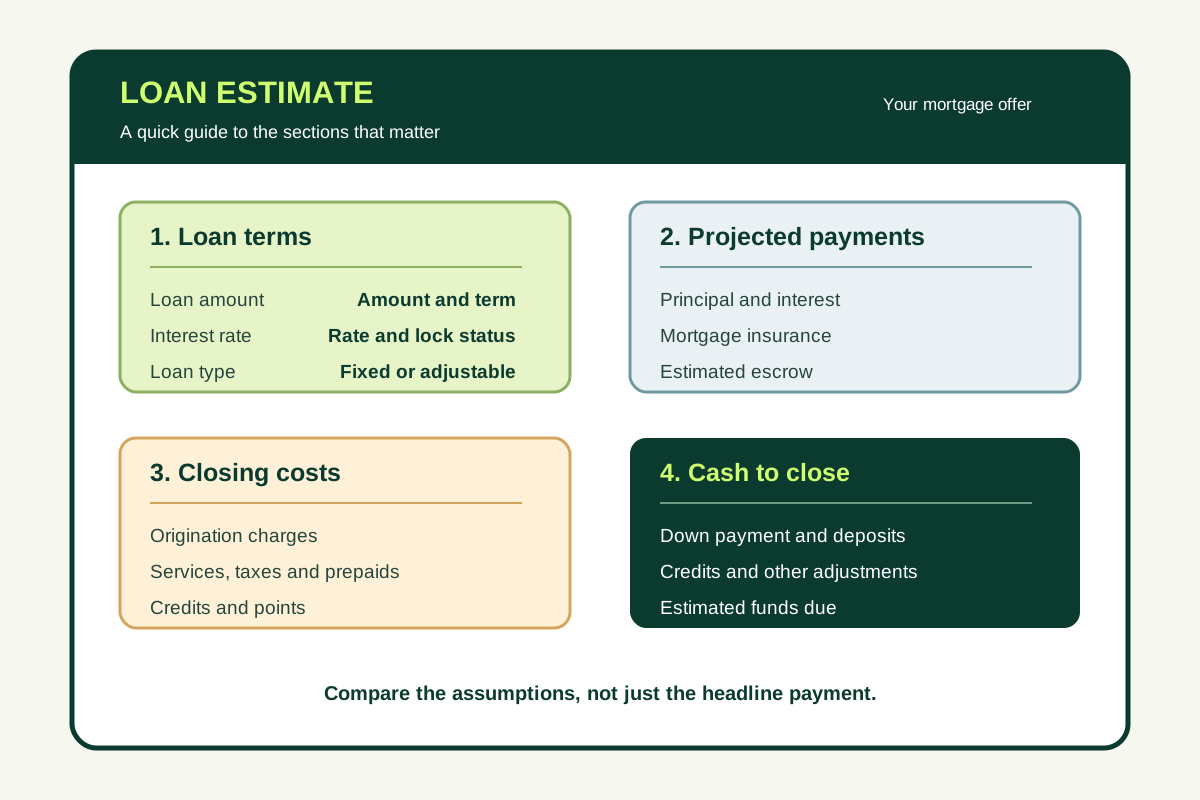
A loan estimate is a standardized form that helps you understand the key terms and costs of a mortgage offer. Knowing how to read its sections can help you compare offers carefully, ask useful questions, and catch details that need clarification. It is not a final closing statement or a guarantee that a loan will be approved.
Ask for personalized mortgage guidance
What is a Loan Estimate?
A Loan Estimate is a form a lender provides after receiving the information required for a mortgage application. It presents important loan terms, projected payments, closing costs, and other details in a consistent format. The Consumer Financial Protection Bureau explains that the form is designed to help consumers understand key features, costs, and risks of a loan offer. Read the CFPB's Loan Estimate guide for an overview.
The form is useful because it puts many details in a familiar order. Instead of trying to interpret a verbal quote or a list of fees in isolation, you can look at loan terms, monthly payments, closing costs, and cash to close in designated sections. That structure makes it easier to identify the questions you need answered. It does not remove the need to understand the assumptions behind the figures.
The amounts are estimates based on information available at the time the document is prepared. They are not a promise of a particular interest rate, payment, approval, or final amount due. Costs and terms may change when permitted, including when more complete information becomes available or circumstances change. If a revised form arrives, ask what changed and why rather than assuming that every difference is an error.
Borrowers commonly use a Loan Estimate when buying a home or refinancing an existing mortgage. The right comparison is between complete offers for a similar transaction, not just between interest rates or monthly payments. Two forms can look different because they assume different loan amounts, terms, property details, points, credits, or rate-lock conditions.
When should you read it, and what should you gather first?
Set aside time to review the form soon after receiving it, while there is still time to ask questions and check assumptions. Gather any earlier quote or estimate, your notes from conversations, the purchase or refinance details you supplied, and any information about a rate lock. You do not need to be a mortgage specialist to perform a useful first review. Your task is to see whether the form describes the transaction you intended and to flag any terms you do not understand.
Start by confirming that you have the complete document and that you know which version you are reviewing. Note its date and keep the prior version if there has been an update. A simple folder, whether digital or paper, can hold the forms, related service quotes, and a running list of questions. Label each file with the lender or provider and date so that you do not compare the wrong versions later.
Next, write down the scenario you expect the form to reflect. For a purchase, that might include the property, estimated price, down payment, and desired loan term. For a refinance, note the approximate existing balance, whether you are considering a rate-and-term change or another objective, and any amount you expect to bring in or receive. These are comparison assumptions, not a substitute for underwriting or a borrower-specific quote.
Make a short review checklist before reading line by line: correct transaction, amount and term; rate and lock status; expected monthly payment; upfront charges; funds due; and open questions. This keeps the review manageable. If one assumption is wrong, ask whether the provider can explain the impact or issue a corrected estimate before you compare the offer with another one.
Where should you start on the form?
Begin at the top of the first page. Confirm the borrower name, property address, estimated property value, loan purpose, and loan term. Check that the form is for the purchase or refinance you are considering. An inaccurate address, property value, or purpose can affect the description of the transaction, so point out an error promptly. Do not assume a detail is harmless just because the payment looks plausible.
Then note the date the form was issued and the date or period shown for the quoted terms. If a rate lock is displayed, read the associated timing and conditions carefully. Do not assume that a rate is locked just because an interest rate appears in the form. Ask directly whether it is locked, when the lock expires, whether it can be extended, and what happens if closing takes longer than anticipated. The answers depend on the specific offer and should be confirmed by the provider.
Identify the loan amount, interest rate, loan type, and whether the rate is fixed or adjustable. Check the loan term as well. A 15-year and a 30-year mortgage can have different monthly payments and total interest even when other assumptions are similar. A shorter term often means paying principal over fewer years, but the appropriate choice depends on the borrower's budget and priorities. Compare the terms shown on the actual forms rather than relying on general rules.
If the estimate describes an adjustable-rate mortgage, find the information about when the initial rate can change and how the form presents possible payment changes. Ask about the adjustment schedule, the index and margin used for the specific loan, and any applicable caps or limits. Do not infer these details from the term “ARM” alone. An introductory rate and payment do not tell you what later payments will be.
Finally, review any checkboxes or descriptions of special loan features, such as a prepayment penalty or a balloon payment, if present. Ask what the feature means in practice and whether it applies to the offer you are considering. If a section is blank or marked in a way you do not recognize, ask the provider to confirm whether it is inapplicable or needs more explanation.
How do you read projected payments?
The projected-payment section gives a monthly view of major housing costs included in the estimate. Depending on the loan and property, it may show principal and interest, mortgage insurance, estimated escrow for property taxes and homeowners insurance, and other applicable costs. The total payment shown is not necessarily every expense of owning the home. Treat it as a starting point for a fuller monthly budget, not as a complete household-cost calculation.
Principal is the portion of a payment that reduces the loan balance, while interest is the borrowing cost. For a fixed-rate loan, the principal-and-interest portion generally follows the agreed payment schedule, but escrow amounts and other costs can change. Taxes and insurance figures may be estimates, and actual bills can differ. If taxes or insurance are not collected through escrow, the payment displayed may exclude amounts you must pay separately.
Read the payment table across the period it covers. Does it show a single payment or more than one projected phase? If the payment is expected to change, find out what event or schedule drives that change. If an adjustable-rate loan is involved, ask when an adjustment could occur and how the documents describe possible payment ranges. Do not treat any illustration as a prediction of future rates or as a cap on every possible housing expense.
Check whether mortgage insurance appears, how much the estimate includes, and whether it is part of the total payment. The type of loan, down payment, borrower qualifications, and program rules can affect whether mortgage insurance applies and how it is treated. Ask what conditions govern its duration or cancellation for the particular loan. Different forms of mortgage insurance do not all work the same way, so do not transfer a rule from one loan type to another.
Make a separate list of recurring costs that may not be included, such as utilities, maintenance, association dues, and costs for services related to the property. For example, a buyer comparing two homes may see similar estimated mortgage payments but face very different association dues or maintenance needs. Those costs are not evidence that one Loan Estimate is wrong; they are part of the broader affordability decision that the form is not designed to settle.
For a practical check, copy the payment components into a personal worksheet and label each one as included, estimated, or paid separately. If a line is unclear, leave it marked “confirm” instead of guessing. This exercise helps you avoid adding escrow a second time or assuming that taxes are covered when they are not. Ask the provider to walk through the total and explain what is and is not included.
What do the loan-cost sections show?
The loan-cost section groups charges associated with obtaining the mortgage. It may include origination charges, services the borrower cannot shop for, and services the borrower can shop for. The labels help you recognize categories, but they do not tell the whole story of what each item covers, who receives payment, or whether you may choose a provider. Ask about a line item if its label is unfamiliar or its amount differs between offers.
Origination charges may include lender- or broker-related charges identified on the form. Do not infer from a general label how a broker is compensated or which party pays a particular charge. Ask the provider to explain the charge, what work or service it represents, who receives it, and whether it is paid by you or another party in the transaction. Confirm the arrangement for your specific offer rather than applying assumptions about all brokers or lenders.
Third-party services can include items such as an appraisal, title work, or other settlement-related services, depending on the transaction. Some services may be ones you can shop for, while others may be arranged under conditions described by the provider. If you can shop, ask what service is required, whether there are timing or provider conditions, and how to submit a quote. Compare providers based on the same scope of work and expected timing, not only on the lowest initial line item.
For example, if one provider lists a service estimate that seems lower than another, check whether both estimates cover the same work and whether the chosen provider can meet the transaction's requirements. A difference may reflect an estimate, a scope assumption, or a choice of service provider. It is reasonable to ask for an explanation and to request information about available choices. Do not assume that a low estimate includes every cost that could arise.
Discount points are upfront charges that may be associated with a lower interest rate, while lender credits may reduce upfront costs in exchange for different pricing. Whether either choice makes sense depends on the exact written offer, how long you expect to keep the loan, your cash needs, and other transaction details. Compare the full set of terms. Points do not always pay off for every borrower, and a credit does not automatically make an offer less expensive overall.
When reviewing a charge, use four questions: What does this line cover? Who receives the payment? Is the amount an estimate or a confirmed charge? Can I choose a provider or another option? Write down the response next to the line. The same questions work for a purchase and a refinance, although the services and transaction details may differ.
What are the other costs?
The other-costs section may include items such as recording charges, taxes, prepaid expenses, initial escrow deposits, and other transaction costs. These do not all represent a fee charged by the mortgage provider. Some are paid to public authorities, while others reflect costs due around closing or funds set aside for upcoming bills. The purpose of the section is to show how such items contribute to the transaction's estimated costs.
Prepaid interest, homeowners insurance, and property taxes can affect the cash needed at closing, depending on timing and applicable requirements. An escrow deposit may be collected to cover future bills. Ask which amounts are estimates, how they were calculated, what dates or billing assumptions they use, and whether a bill, policy quote, or other supporting information is available. It is useful to separate the amount of a cost from the timing of when it must be paid.
Some costs may be adjusted between the parties or affected by the transaction details. For a purchase, the contract and any agreed contributions may affect the amount shown. For a refinance, existing obligations and settlement arrangements can influence the totals. Ask how a credit or adjustment is reflected and whether it is already counted elsewhere. The answer should explain the form's arithmetic, not just repeat the final total.
Compare the sections before deciding whether the total looks high or low. A higher cash-to-close figure might reflect a down payment, prepaid items, or an escrow deposit as well as loan charges. A lower figure might reflect a credit or different assumptions. That does not by itself mean the lower-cost loan is less expensive over time. Separate expenses that are part of the loan offer from cash needed because of timing, property, or transaction arrangements.
How should you interpret cash to close?
Cash to close is the estimated amount the borrower may need to bring to complete the transaction. It generally combines the down payment and closing costs, then accounts for credits, deposits, and other adjustments shown on the estimate. The final amount can change as the transaction progresses. It is a useful planning figure, but it is not the same thing as a lender's fee total or a guaranteed final amount due.
For a purchase, distinguish the down payment from loan-related costs, prepaids, and other funds. Confirm whether money already paid, such as an earnest-money deposit, is reflected in the estimate. Ask whether any seller contribution has been assumed and how it is applied. If a deposit or credit is missing, ask how that affects the total, but do not change your own records based on an unconfirmed assumption.
For a refinance, inspect the line items that account for existing obligations, credits, and other settlement items. If the estimate suggests that funds may go to the borrower, treat the figure as an estimate rather than a promise of cash proceeds. The actual outcome depends on the final transaction and applicable review. Ask the provider to explain whether the amount shown assumes that you will bring funds, receive funds, or make a different arrangement.
One useful method is to make a simple cash-to-close bridge in your notes: start with the amount shown, list each down-payment or cost component, subtract each deposit or credit, and identify adjustments that remain uncertain. You do not need to calculate a new official figure. The point is to see the logic and to identify where your understanding differs from the form. Ask for clarification on any component that does not reconcile.
Also plan for costs that may be due around the same time but do not appear in the estimate, as well as the reserves you want to keep after closing. The Loan Estimate cannot decide how much cash is comfortable for your household. Avoid making a major financial decision based only on the preliminary amount; confirm the current figures and timing with the relevant providers as the transaction develops.
How can you compare two Loan Estimates fairly?
Key takeaway: compare like with like, not just the headline payment. Use this short checklist before drawing conclusions:
- Match the scenario: Compare the same purpose, property, loan amount, down payment, term, and general loan structure.
- Check timing: Confirm that the rate-lock status and relevant dates are comparable.
- Resolve differences: If an estimate uses a different property value, loan program, or service arrangement, ask for a comparable version.
Then use a side-by-side worksheet to record the assumptions and unanswered questions for each form.
Record the loan amount and term; fixed or adjustable structure; interest rate and lock status; principal-and-interest payment; mortgage insurance and escrow; lender or broker charges; third-party services; points or credits; other costs; and cash to close. Add a notes column for unanswered questions and a source column to identify which form or explanation supports each entry.
- Loan terms: Compare the amount, term, fixed or adjustable structure, and any special condition shown on the form.
- Rate and lock: Confirm the interest rate and whether it is locked, including the lock period and any stated conditions.
- Monthly costs: Compare principal and interest with mortgage insurance, escrow estimates, and any projected changes.
- Upfront costs: Review origination charges, points, lender credits, third-party services, taxes, and prepaids.
- Cash to close: Separate down payment from loan-related charges and other funds due, and check which deposits or credits are included.
- Longer-term fit: Consider how the term, rate structure, and upfront choices fit your expected time in the home or loan.
The Annual Percentage Rate (APR) can help summarize certain borrowing costs in relation to the loan amount, but it should not be used alone to choose an offer. The calculation has assumptions and may not capture every personal circumstance. Loans with different terms or features may not be directly comparable. If two APRs seem close while fees, points, or loan structures differ, ask the providers to explain what the APR includes and what it does not resolve for your situation.
Imagine that one estimate has a lower interest rate but higher upfront charges, while another has a different rate and a credit that reduces the amount due at closing. Neither is automatically the better fit. A borrower who expects to keep a loan for a shorter period may evaluate upfront costs differently from a borrower planning to keep it longer, but personal plans can change. Ask for comparable written options and understand the assumptions behind any break-even discussion instead of relying on a generic rule.
Likewise, a lower monthly payment may result from a longer repayment term, a different loan amount, an introductory adjustable rate, or other changes. It does not by itself prove that the offer has a lower total cost. Look at the full structure and think about how long you may keep the home or loan, what payment changes are possible, and how much cash you can reasonably use at closing. The comparison should answer your needs, not reward a single lowest figure.
How do points and lender credits affect a comparison?
Points and lender credits can make two offers look different even when their main loan terms appear similar. Points are an upfront cost that may be associated with a lower rate. A lender credit may reduce upfront costs in exchange for different pricing. The Loan Estimate shows the terms of a particular offer, but it cannot decide whether paying more upfront or retaining more cash is best for you.
When considering points, ask the provider to show the offer without points and with the points under otherwise comparable assumptions, if those options are available. Compare the change in upfront cost with the change in the payment and rate. Then consider how long you think you may hold the loan, whether your plans could change, and whether using cash upfront would leave sufficient funds for other needs. Avoid treating a simple break-even date as certain; it depends on assumptions about future events and costs.
When considering a lender credit, find out which costs it offsets and what pricing applies. A credit that helps with cash needed at closing may be valuable to a borrower who wants to preserve funds, but it is not free money and should be evaluated alongside the rate, total costs, and expected time with the loan. Confirm that the credit is reflected in the estimate and ask whether it can be used for the costs you expect.
Do not compare a points option from one provider with a credit option from another without making the differences explicit. Ask for a consistent set of choices: similar loan amount, term, rate-lock assumptions, and fee presentation. Write down what changes when the pricing choice changes. If the provider cannot explain an apparent tradeoff in plain language, ask for a clearer written comparison before selecting an option.
What can change after you receive it?
A Loan Estimate is prepared using information and assumptions available at a particular point. A revised estimate may be provided when a permitted change affects the transaction. The reason and timing matter, so ask what changed, when the provider learned about it, and which costs or terms are different. Do not assume that an update is automatically improper or automatically correct; review it and request an explanation.
Changes might relate to updated application information, property details, a change in the loan selected, or other circumstances recognized under applicable rules. A different loan amount, property estimate, service selection, or transaction detail may lead to a different form. Ask the provider to connect the new information to the specific lines that changed. A general statement that “the numbers were updated” may not answer your practical question.
Keep every version and compare them line by line. Mark the date, note the changed amount or term, and record the provider's explanation. Check whether the interest rate, rate-lock status, lender credit, third-party service estimate, projected payment, or cash-to-close figure changed. If the rate lock or another deadline is relevant, ask whether the update affects it and what action, if any, you need to take.
Some numbers can change because they were estimates; other changes may require a specific explanation. Ask which figures are expected to be stable and which remain subject to change. If you believe a basic fact is wrong, provide the correct information and ask whether a corrected form is appropriate. Maintain a record of the question and answer so that you can explain the history if another update arrives.
How is a Loan Estimate different from a quote or pre-approval request?
A personalized quote or early comparison can help you explore possible options, but it is not the same as a formal Loan Estimate. A Loan Estimate is a standardized disclosure associated with a mortgage application. A quote may be based on limited information and may not include all the transaction details needed for a formal estimate. Confirm what document you received and what assumptions it uses before treating it as a basis for comparison.
A pre-qualification or pre-approval request is also distinct from an issued letter, a final credit decision, or a guarantee of funding. Submitting an inquiry can begin a conversation about a possible transaction, but it does not establish that a borrower or property meets the requirements for a particular loan. The eventual terms depend on borrower, property, lender, program, and transaction review.
Great Western Funding provides online paths for purchase loan and pre-approval requests and refinance analysis requests. These are starting points for discussing a scenario, not a formal Loan Estimate by themselves. An initial request or analysis being offered without charge does not mean that a mortgage has no costs. Ask what information is needed to discuss your situation and what the next step represents.
How should purchase borrowers use the form?
For a purchase, the form connects the proposed mortgage to a particular home-buying transaction. Check that the property assumptions and loan amount reflect the scenario you are considering. Compare the down payment, estimated closing costs, prepaid expenses, credits, and cash to close. If a purchase contract or deposit changes, ask whether the estimate needs to be updated and how the change affects the amounts shown.
First-time buyers may find it helpful to separate the money into three buckets: funds applied toward the purchase price, costs of obtaining and settling the loan, and amounts collected for expenses that arise around closing. The categories can be easy to blend together when looking only at the total due. Ask the provider to identify which items are lender-related, which are third-party services, and which reflect taxes, insurance, escrow, or other transaction details.
If you are exploring a program such as FHA, VA, USDA, or a renovation-related mortgage, keep the program's name separate from a conclusion that you qualify. Eligibility and terms depend on borrower, property, lender, and program rules. A form for one loan type should not be compared with a different program without noting the different requirements, costs, and assumptions. Ask how the particular option is evaluated rather than relying on a broad program description.
For veterans and eligible surviving spouses, it can be appropriate to ask whether a VA-related option may fit the circumstances. Rural buyers can ask whether a USDA-related option is available for their situation. Neither a conversation nor an initial request establishes eligibility. If renovation financing is being considered, ask how the proposed work, property, and loan requirements are assessed; do not assume that every renovation project qualifies.
As you prepare, keep a list of the costs that are not part of the mortgage estimate but matter to your purchase decision. This could include moving costs, necessary repairs, utility setup, or association dues, depending on the property. The goal is not to add unsupported numbers to the estimate. It is to avoid treating the lender's cash-to-close calculation as the entire amount of money you may want available around a move.
How should homeowners use it when refinancing?
For a refinance, compare the proposed new loan with the current mortgage and the reason you are considering a change. The purpose may involve a different rate or term, a payment objective, or another financing goal. Review the proposed loan amount, rate, term, fees, points or credits, prepaids, and cash-to-close estimate. Do not judge the transaction by one projected monthly payment alone.
A lower monthly payment may reflect a longer repayment period or a different loan structure, and it does not by itself show that the refinance costs less overall. Consider how the new term affects the time you will repay the debt and how much is due upfront. If you plan to sell or refinance again before recovering upfront costs, that possibility may matter; if your plans are uncertain, make that uncertainty explicit rather than assuming a fixed timeline.
If you are exploring cash-out, treat any amount shown as an estimate, not a promise of proceeds. Ask how the loan amount is calculated and what costs or existing obligations are included. Consider the purpose of the funds and the effect of replacing the current mortgage with a new obligation. The estimate can help describe the transaction, but it does not decide whether using home equity for a particular goal is appropriate.
A useful refinance comparison includes the current loan's remaining term and payment arrangement alongside each proposed option. Write down what changes: rate structure, repayment term, monthly obligations, upfront costs, and estimated cash needed. If an option reduces the payment but extends repayment, note that tradeoff. If an option has upfront points or a credit, evaluate how those terms interact with the time you expect to keep the new loan.
Great Western Funding offers a refinance analysis request for homeowners who want to discuss their scenario. A request is a starting point, not a promise of a lower payment, approval, or cash-out proceeds. Ask which details are needed to prepare a meaningful comparison and how any estimate differs from the formal disclosures for a mortgage application.
How can a calculator help, and what can it not tell you?
A mortgage payment calculator can help you explore how loan amount, term, and interest assumptions affect a principal-and-interest estimate. It can be useful when you want to test one change at a time, such as comparing the effect of a different term or seeing how a changed loan amount affects a hypothetical payment. The Great Western Funding mortgage calculator is an online tool for estimates.
Use the tool with clearly labeled assumptions. Save or write down the inputs, and do not compare one result based on a different term or loan amount as if it were the same scenario. If the tool permits additional inputs, note which costs are included. If a value is unknown, do not invent one simply to produce a precise-looking result. A range of scenarios can support planning, but the outputs remain estimates.
A calculator result is not an offer, underwriting decision, or complete housing budget. It may not include taxes, insurance, mortgage insurance, association dues, or transaction costs unless those inputs are supplied and the tool supports them. It also cannot confirm eligibility, service-provider charges, a rate lock, or the final cash needed for a particular transaction. Use the formal estimate and the provider's explanations to understand the actual offer.
Think of a calculator as a question generator. If a modest change in an input has a material effect on the result, ask how reliable that input is for your scenario. If a payment looks comfortable only when an expense is excluded, identify that expense before proceeding. Do not use a calculator output as proof that a mortgage is affordable or available.
What questions should you ask about the form?
Use the estimate to start a focused conversation. You do not need to ask every question at once. Begin with any item that is incorrect or unclear, then move to rate status, costs, and the cash-to-close calculation. Ask for plain-language answers and, when helpful, a written explanation tied to the line on the form.
- Does the form reflect the correct borrower, property, purpose, loan amount, and term?
- Is the interest rate locked? If so, until when, and what conditions or extension terms apply?
- Which charges are paid to the lender, broker, or third-party providers, and what does each cover?
- Which services may I shop for, and what must a selected provider deliver?
- How were taxes, insurance, escrow deposits, and prepaid amounts estimated?
- Which deposits, credits, or contributions are included in the cash-to-close amount?
- Could the payment change, and where does the form describe that possibility?
- What assumptions explain the difference between this form and another offer?
- What information or event could lead to a revised estimate?
- How will the costs and terms be confirmed as the transaction approaches closing?
Ask the provider to walk through a line item rather than simply asking whether the estimate is “good.” For instance, point to a charge and ask what service it represents, whether the amount is estimated, and whether you have a choice about the provider. Point to the projected payment and ask which parts may change. A clear question makes it easier to receive an answer you can compare with another offer.
If you are comparing offers from more than one source, share the assumptions that matter and ask each provider to clarify differences. You can ask whether an offer can be shown on a comparable basis, while recognizing that loan products and terms may not be identical. Keep the written documents and avoid treating a verbal explanation or informal quote as a final offer.
What common mistakes should you avoid?
- Focusing only on the interest rate. Points, credits, fees, term, rate-lock conditions, and projected payment structure also matter.
- Treating an estimate as a guarantee. It is an estimate based on current information, not final approval or a promise of funding.
- Comparing mismatched scenarios. Different loan amounts, terms, properties, or lock status can distort a comparison.
- Ignoring future payment details. If an adjustable-rate loan or another payment change is shown, understand timing and conditions rather than looking only at the initial amount.
- Confusing cash to close with lender fees. It can include down payment, prepaids, deposits, credits, and adjustments.
- Assuming every number is fixed. Ask which figures are estimates, what assumptions support them, and why they might change.
- Counting the same cost twice. Check whether escrow or another item is included in the payment and also listed elsewhere as a closing amount.
- Assuming a low line item covers every service. Confirm the scope, timing, and requirements before comparing service estimates.
- Relying on a calculator as a quote. Use a calculator for planning, then review formal transaction documents and explanations.
- Choosing by a single total. Cash due, monthly payment, and longer-term cost answer different questions; consider them together.
A disciplined review does not require you to predict every future cost. It means you notice what the form says, distinguish estimates from confirmed facts, and ask for clarification where the difference could affect your decision. If the response changes your understanding, update your notes and compare the latest version rather than relying on an older form.
How can you make a simple comparison plan?
Take the review in three passes. In the first pass, check identity and purpose: does the form describe the right borrower, property, and transaction? In the second pass, review the loan structure and monthly payment: amount, term, fixed or adjustable features, rate-lock status, payment components, and possible changes. In the third pass, follow the money: origination, services, points or credits, prepaids, deposits, and cash to close. This sequence moves from the basic assumptions to the detailed costs.
After those passes, compare your notes across offers. Circle differences you can explain, such as a different term or an optional pricing choice. Put a question mark beside differences you cannot explain. Contact each provider with the same neutral question, such as “What assumption causes this line to differ?” Keeping the questions consistent makes the answers easier to compare and avoids focusing on a number before you know what it represents.
Then assess the options against your own priorities. One borrower may place greater importance on preserving funds for closing and moving. Another may focus on payment stability or a particular term. A homeowner refinancing might care about the effect of a new repayment period, while a buyer may be focused on the cash needed to complete the purchase. These priorities are personal; the Loan Estimate gives information for the decision, not a universal ranking of offers.
Before acting, confirm that you have the most recent documents and understand any deadlines or lock conditions that apply. Ask what the next document or step will be and how it differs from the estimate. Keep copies of updated forms and final answers. This final check helps ensure that your choice is based on the offer you actually intend to pursue rather than on an outdated quote or an assumption that has since changed.
Discuss your purchase or refinance questions
Frequently asked questions
Is a Loan Estimate a commitment to lend?
No. It describes estimated terms and costs based on information available at that point. It is not final approval, a guarantee of funding, or a promise that every listed figure will remain unchanged. Ask the provider what further review and documentation apply to your situation.
Does a Loan Estimate include every cost of owning a home?
No. It focuses on mortgage terms, projected payments, and transaction costs shown for the loan. Some ongoing expenses, such as utilities, maintenance, or association dues, may not be included. Consider those costs separately when assessing a household budget.
Can I ask questions about charges or services?
Yes. Ask what a charge covers, who receives it, whether the amount is an estimate, and whether you can shop for the service. Ask the provider to explain choices and conditions. Do not assume every charge can be changed or removed.
What should I do if two estimates are different?
First check whether the loan amount, property, term, rate-lock status, and other assumptions match. Then compare payment and cost categories line by line and ask the providers to explain differences. Request a comparable written scenario when possible, and keep track of any differences that cannot be made identical.
Where can I start if I am buying or refinancing?
You can contact Great Western Funding to discuss a purchase or refinance scenario and request guidance. An initial request does not establish approval or guarantee particular terms. You can also review the purchase and refinance request paths linked above.
Take time to review every section, confirm the assumptions, and get clear answers before you compare or choose a mortgage offer.
